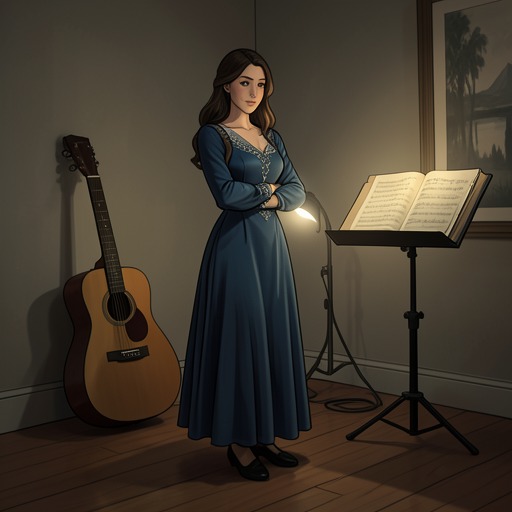
Ash Grove
Daisy Jones & the SixAsh Grove is the setting for a decisive early moment in Daisy Jones’s musical life: in the summer of 1972, she stepped onstage with Mi Vida and sang in public for the first time at the insistence of the band’s front man, Jim Blades. The venue matters not for any described feature of its physical surroundings, but as the place where Daisy’s private songwriting ambition met an audience—and where those present saw that she could command one.
Setting and occasion
Daisy attended a Mi Vida show at Ash Grove while dating Jim Blades, the group’s lead singer. She had been trying to establish herself as a songwriter outside the Sunset Strip, despite having no musical training. With only pen and paper, she had assembled a songbook containing rough sketches of more than a hundred songs. Until the Ash Grove appearance, her singing had largely remained outside public performance: Jim had repeatedly encouraged her to sing with him, and she had always refused.
Simone Jackson was with Daisy at the show. Her memory places the two of them at the back while the performance was underway. The account gives no description of Ash Grove’s layout beyond that vantage point and the stage, but it establishes the setting’s immediate social scale: Daisy was among the audience until Jim’s repeated requests drew her toward the band.
The invitation and hesitation
Jim’s invitation came toward the end of Mi Vida’s set, but Simone recalled that he had been trying to persuade Daisy for much of the night. Daisy kept saying no before eventually agreeing to go onstage. That hesitation is central to the episode: her appearance was not presented as the routine next step for an already confident performer, but as a threshold she was reluctant to cross even while she wanted to write songs.
When Daisy stood before the audience, she experienced the attention as surreal. She was conscious of people looking at her and expecting something to happen. Simone likewise remembered an initially timid performance, which surprised her. The scene therefore turns on a visible change rather than a sudden, unexplained ease: Daisy began cautiously, with the crowd’s attention bearing down on her, and grew more assured as the song continued.
A performance that changes the room
Daisy and Mi Vida performed a cover of “Son of a Preacher Man.” Around the second chorus, Simone saw Daisy let go of her reserve. Daisy was smiling and appeared happy onstage; the audience could not take its eyes off her. As the song neared its end, Jim stopped singing and left the performance to Daisy. Simone remembered her bringing down the house, a response that made the appearance consequential beyond the fact that Daisy had finally accepted an invitation.
Jim’s recollection explains what he heard in that performance. Daisy’s voice had a gritty quality without becoming scratchy, giving the songs she sang complexity and unpredictability. He also noted that she sang naturally from deep in her belly, a technique that other people might take years to learn. At Ash Grove, those qualities were no longer only part of the informal singing Jim had heard in everyday settings; the audience encountered them as a public performance.
Significance in Daisy’s early career
Jim understood Daisy’s reluctance in relation to her songwriting ambition. He believed that the strongest thing her songs had going for them was the possibility that she would sing them, and that her ability to hold people’s attention was an asset she should use. His encouragement connects the Ash Grove show to a practical question facing Daisy as a songwriter: whether to remain the person writing songs or also become their public voice.
The show does not establish that Daisy immediately began a performing career, nor does the account provide details about the venue beyond this appearance. Its importance is narrower and more specific: here, after resisting Jim for most of the evening, Daisy sang before a crowd, found her confidence during the song, and received a strong response. Ash Grove thus marks an early passage from work on a growing songbook to the public act of performing one of the songs she could, in Jim’s view, make her own.